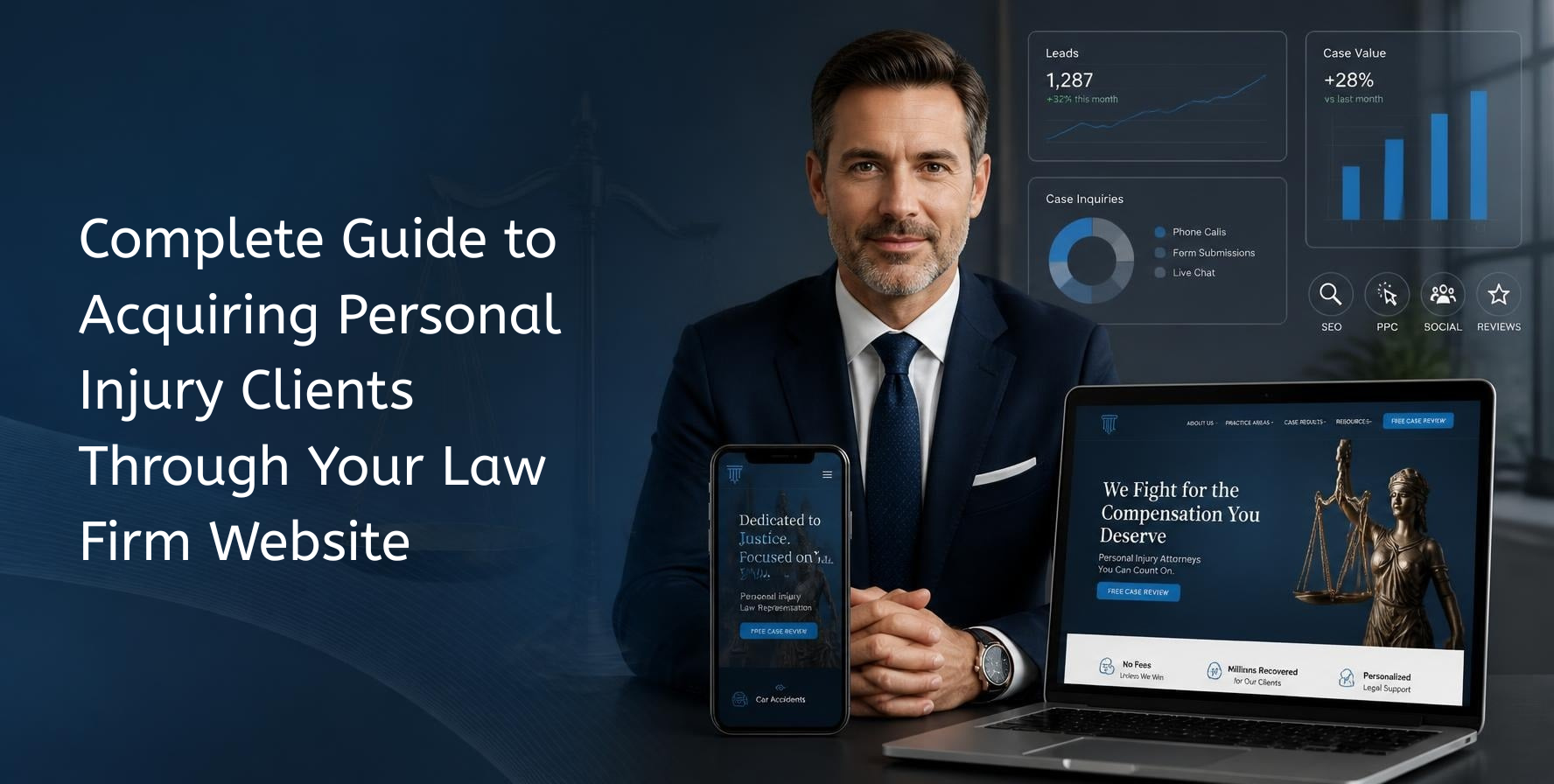

Acquiring personal injury clients through your law firm website can be challenging if you don’t have a well-defined strategy. Today, we discuss some proven strategies for acquiring personal injury clients through your law firm website that can help you improve your results.
Executive Summary
For most modern personal injury firms, the website has evolved from a digital brochure into the firm’s primary client acquisition engine. While referrals remain valuable, over 80% of prospective legal clients begin their search online, often making a hiring decision before ever speaking with an attorney. Success today depends on much more than ranking in Google—it requires a website engineered to convert injured visitors into signed clients.
This guide examines the current best practices, proven conversion methodologies, SEO strategies, AI search optimization, and real-world case studies specifically related to personal injury law firms.
The Complete Guide to Acquiring Personal Injury Clients Through Your Law Firm Website
SEE ALSO: The Efficacy, Reach, and Influence of Radio Advertising in the Personal Injury Sector
-
Chapter 1: Understanding the Modern Personal Injury Client Journey
Today’s injury victim rarely follows a straight path.
A typical client journey looks like:
Accident Occurs
        │
        ▼
Google Search
        │
        ▼
Reads 3-8 Law Firm Websites
        │
        ▼
Checks Google Reviews
        │
        ▼
Looks at Settlements
        │
        ▼
Researches Attorney
        │
        ▼
Visits Social Media
        │
        ▼
Calls 1-3 Firms
        │
        ▼
Signs With First Firm That Builds Trust
The website influences nearly every step.
The objective is no longer simply generating traffic.
The objective is:
Turn high-intent visitors into consultations as quickly as possible.
-
Chapter 2: The Five Pillars of Personal Injury Website Client Acquisition
-
Pillar 1 — High Intent Traffic
Traffic quality matters far more than traffic volume.
High-value searches include:
- Car accident lawyer near me
- Truck accident attorney Dallas
- Slip and fall attorney
- Motorcycle accident lawyer
- Wrongful death attorney
- Pedestrian accident attorney
Lower-value searches:
- What is negligence?
- Car accident statistics
- Personal injury law
Educational content builds authority, but service pages convert.
-
Pillar 2 — Trust
In personal injury law, trust is everything.
Visitors ask themselves:
- Can I trust this lawyer?
- Have they handled cases like mine?
- Will they actually answer the phone?
- Are they successful?
Trust signals include:
- Attorney photos
- Office photos
- Google Reviews
- Video introductions
- Million-dollar settlements
- Bar memberships
- Super Lawyers
- Board Certifications
- BBB Accreditation
- Media mentions
- Client testimonials
- Published verdicts
-
Pillar 3 — Speed
Studies consistently show that slower websites convert fewer visitors. Practical recommendations across legal marketing emphasize keeping pages fast, mobile-friendly, and under roughly three seconds to load.
For law firms:
- Compress images
- Use CDN
- HTTP/3
- Brotli Compression
- Server-side caching
- Cloudflare
- Fast hosting
-
Pillar 4 — Conversion Optimization (CRO)
Most firms obsess over SEO.
The highest-performing firms obsess over conversion rate.
Industry benchmarks suggest many PI websites convert only about 2–5% of visitors into leads, while optimized firms can achieve materially higher conversion rates through systematic CRO.
-
Pillar 5 — Immediate Response
Lead response speed is one of the biggest competitive advantages.
Features include:
- Live chat
- SMS
- Call answering
- AI intake
- Online scheduling
- Instant consultation booking
-
-
Chapter 3: Website Architecture That Converts
An effective PI website is organized around the way prospective clients search.
Homepage

Practice Areas

Car Accidents

Truck Accidents

Motorcycle Accidents

Wrongful Death

Slip and Fall

Medical Malpractice

Dog Bites

Construction Injuries

Brain Injuries

Burn Injuries

Spinal Injuries

Local City Pages

Attorney Profiles

Results

Testimonials

FAQ

Contact
Each practice area should have:
- Original copy
- Localized examples
- FAQs
- Attorney profile
- Settlement examples
- Related cases
- Internal links
-
Chapter 4: Service Pages That Generate Cases
High-converting service pages typically outperform long, keyword-stuffed pages because they answer users’ immediate questions, establish credibility early, and make contacting the firm easy. (per Houston Law Firm SEO)
Recommended structure:
Hero Section
Injured in a Dallas Car Accident?

Speak with an Attorney Today.

No Fee Unless We Win.

Free Consultation.

[Call Now]
Immediately below:
- Reviews
- Settlements
- Awards
- Phone number
- Attorney photo
Then:
Problem
↓
Solution
↓
Experience
↓
Results
↓
Process
↓
FAQ
↓
CTA
-
Chapter 5: Local SEO for Personal Injury Firms
Google Business Profile remains one of the highest ROI assets.
Optimize:
- Categories
- Reviews
- Photos
- Q&A
- Services
- Weekly Posts
- Videos
City Pages
Instead of:
Dallas Personal InjuryCreate:
Dallas Car Accident Lawyer

Plano Car Accident Lawyer

Garland Car Accident Lawyer

Mesquite Car Accident Lawyer

Irving Car Accident Lawyer
Each page should contain original local content.
-
Chapter 6: AI Search Optimization (AEO)
Search behavior is changing as Google AI Overviews and conversational AI tools become a larger part of discovery.
Recent guidance from HubSpot emphasizes:
- Answer conversational questions directly.
- Use structured content and schema.
- Include original insights and data.
- Expand visibility beyond the blog through YouTube, newsletters, podcasts, and other authoritative sources.
HubSpot reports substantial improvements after adopting an AI-focused content strategy, including a large increase in qualified leads and higher conversion rates from AI-referred visitors.
For PI firms, optimize content for questions like:
- “Should I hire a lawyer after a rear-end accident?”
- “How much is my whiplash claim worth?”
- “Can I sue after a truck accident in Texas?”
Use FAQ schema, attorney schema, review schema, and local business schema where appropriate.
-
Chapter 7: Conversion Rate Optimization
Every page should answer four questions quickly:
- Can you help me?
- Can I trust you?
- Have you done this before?
- How do I contact you?
Recommended homepage above-the-fold elements:
✓ Attorney photo
✓ Phone number
✓ CTA button
✓ Review stars
✓ Settlements
✓ Awards
✓ Free consultation
✓ No fee unless we win
Forms
Avoid lengthy forms.
Request only:
- Name
- Phone
- Brief description
Calls to Action
Examples:
- Speak With an Attorney Now
- Free Case Review
- Start Your Claim
- Talk to a Lawyer Today
-
Chapter 8: Video Marketing
High-performing firms increasingly use video throughout their sites.
Recommended videos:
Homepage
Attorney introduction
Practice area explainers
Case studies
Client testimonials
Frequently asked questions
Office tour
Research cited in recent legal marketing reports suggests pages with video often convert better than comparable pages without it.
-
Chapter 9: Reviews
Reviews influence nearly every hiring decision.
Best practices:
Ask every satisfied client.
Respond professionally.
Embed reviews.
Use video testimonials when possible.
Show review counts prominently.
-
Chapter 10: Case Results
Visitors love proof.
Display:
Verdict
Settlement
Case Type
Outcome
Recovery
Example:
$2.8 Million Commercial Truck Accident Dallas County Neck Injury -
Chapter 11: Technical SEO
Critical components include:
XML Sitemap
Canonical URLs
Schema
Core Web Vitals
HTTPS
Fast hosting
Image optimization
Breadcrumbs
Internal linking
Clean URLs
-
Chapter 12: Analytics
Track every lead source.
Recommended stack:
GA4
Google Tag Manager
CallRail
Microsoft Clarity
Google Search Console
CRM
Phone tracking
Form tracking
Chat tracking
Campaign tracking
Key metrics include:
- Organic traffic
- Local rankings
- Phone calls
- Form submissions
- Consultation bookings
- Signed cases
- Cost per signed case
- Revenue per channel
-
Chapter 13: AI Intake
Many firms now deploy AI-assisted intake to capture leads after hours.
Capabilities include:
- Answer FAQs
- Collect accident details
- Schedule consultations
- Route emergencies
- Transfer to live staff
- Capture leads 24/7
AI should complement—not replace—human intake, especially for sensitive legal matters.
-
Chapter 14: Content Marketing
Rather than publishing generic legal articles, prioritize content that reflects real client intent.
Examples:
How long do I have to file a Texas car accident lawsuit?
What if the other driver has no insurance?
Should I accept the insurance company’s first offer?
What happens after hiring a lawyer?
These questions often align more closely with consultation-ready visitors than broad educational topics.
-
Chapter 15: PPC Landing Pages
Paid traffic should rarely land on the homepage.
Instead, build dedicated pages with:
No navigation distractions
Single CTA
Phone number
Attorney photo
Reviews
Case results
Practice-specific content
Local references
Fast form
-
Chapter 16: Case Studies
Case Study: Atlanta Personal Injury Firm
A newly established Atlanta PI practice implemented a conversion-focused website combined with SEO and reported:
- #1 Google ranking for its target keyword
- Approximately 480% increase in organic traffic
- Expansion into more than 25 markets
- Significant growth in leads and signed cases over the engagement period, according to the published case study.
Case Study: Texas Personal Injury Firm
A Texas PI firm reported:
- 276% organic traffic growth
- 295+ new ranking keywords
- Approximately 33% increase in signups
- Website conversion rates exceeding 10% after optimization, compared with lower baseline performance. (per LaGrande Marketing)
Conversion Benchmark Data
Recent industry reports cite benchmarks such as:
- Average website conversion around 2.8–2.9%
- High-performing firms exceeding 10% and, in some specialized scenarios, substantially higher
- Faster lead response associated with dramatically higher contact and consultation rates
- Local Services Ads frequently converting at higher rates than traditional search ads because of their high-intent audience. (per LEXGRO)
-
Chapter 17: The Future of Personal Injury Website Marketing
The firms that will dominate the next decade are likely to combine:
- Traditional SEO
- AI search optimization (AEO)
- Local SEO
- Video-first content
- Review generation
- First-party analytics
- AI-assisted intake
- Rapid response systems
- Conversion-rate optimization
- Original legal insights and resources that distinguish them from competitors
Rather than viewing the website as a static brochure, successful firms increasingly treat it as a continuously optimized client acquisition platform.
Recommended Resources
SEO & Digital Marketing
- Google’s Search Essentials: https://developers.google.com/search/docs
- Google Business Profile Help: https://support.google.com/business
- HubSpot’s recent AEO guidance for adapting content to AI-driven search.
Legal Marketing
- Best Lawyers – High-Converting Law Firm Landing Pages
- Case Quota – SEO Guide for Personal Injury Attorneys
- Slamdot – Conversion Tips for Personal Injury Law Firms
Case Studies
- TruLaw Marketing – Atlanta Personal Injury Law Firm SEO Case Study
- LaGrande Marketing – Texas Personal Injury Firm Growth Case Study
For firms in highly competitive metropolitan markets, the most sustainable strategy is to integrate technical SEO, localized authority-building, persuasive conversion design, rapid intake, and AI-ready content into a single, measurable client acquisition system rather than relying on any one marketing channel alone.
Conclusion
We hope you’ve found this guide to acquiring personal injury clients through your law firm website helpful. By implementing the strategies defined above, you can expect to increase your personal injury caseload in the near future!